

A story told by a powerful demon about a question asked by a boy: “Who has gone?”
Find out for yourself—who is the boy, who is the demon, and who has gone?
To understand this story, we must go back in time—millions of years ago. This is a true account, mentioned in the great scripture Srimad Bhagavata Purana.
There was a great kingdom called Ushinara. Suyajna, a mighty and valorous king, ruled the land. He was an ambitious, passionate ruler who sought to expand his kingdom as far as possible. Over time, he fought many battles and conquered numerous territories. He became an emperor. But the powerful force of Time had already sealed his destiny.
In one of his expansion campaigns, the king lost his life in battle. When the news of his death reached his wives, ministers, and citizens, they were overwhelmed with grief. They loved their dear king deeply—not only because of his affection but also for his victories, which brought wealth and fame. The heart-breaking news led to widespread lamentation.
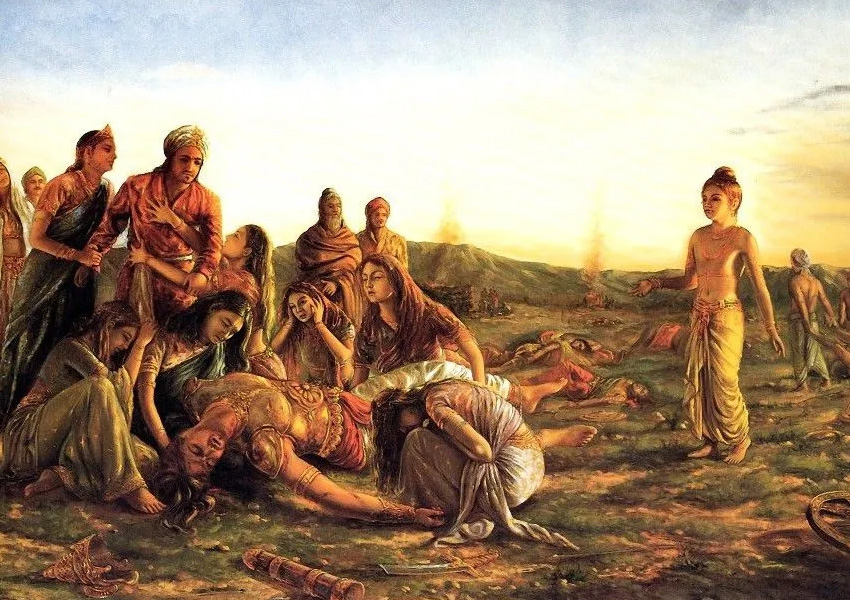
The queens and ministers rushed to the battlefield. The queens placed the lifeless body of the king in their laps and cried bitterly. As the sun began to set and the time for the king’s final rites approached, they refused to move from the spot.
This sorrowful scene somehow reached the heavenly realms. Yamaraj, the lord of death, was moved by their pain. Out of compassion and a desire to enlighten them with real knowledge, he assumed the form of a small child and came to the battlefield. Being a child, no one stopped him. He walked straight to where the queens were weeping and listened to their cries.
They wailed in intense grief, calling out, “My dear King Suyajna, you have gone! You have gone!” After observing them for a while, the boy finally spoke. He said:
“I see that you are all elders and learned people, yet I am unable to understand the truth in your words. You say, ‘He has gone’—but who has gone?”
He then addressed them with the following words, as recorded in the scripture:
“O lamenters, you are all fools! The person named Suyajna, for whom you lament, is still lying before you and has not gone anywhere. Then what is the cause of your lamentation? Previously, he heard you and replied to you, but now, not finding him, you are grieving. This is contradictory behavior—for you have never actually seen the person within the body who heard and replied to you. There is no need to lament, for the body you always saw is still lying here.”
— Srimad Bhagavatam 7.2.44
Let’s shed some light on this profound verse.
The boy presented two key points:
First – “You are all lamenting for King Suyajna, saying that he has left you. But I see his body lying right in front of you. The one you saw every day, the one who spoke to you and heard you, is still here. So, why do you say he has gone?”
Second – “If you claim that the one who heard and spoke to you has indeed gone, then you never actually saw him—because the body you always saw is still here. So why do you lament for someone you never saw?”
The boy continued:
“My dear queens and ministers, everything is under the control of the Supreme Personality of Godhead, in the form of Time. Understand the power of Time. Living beings move from one body to another by Time’s arrangement. Every individual has a designated lifespan. Once that time ends, we must leave the body. Nothing happens by chance—everything is perfectly orchestrated. The person within the body—the soul—is eternal. The soul does not die when the body dies.”
And thus, our thoughtful and philosophical story comes to an end.
For your understanding:
- The boy was Yamaraj.
- The demon who told the story was Hiranyakashipu.
- The king who died was Suyajna.
This story is found in the Srimad Bhagavata Purana.
A similar message is conveyed by Lord Sri Krishna in the Bhagavad-gita:
The soul is eternal. And there exists an eternal Kingdom of God, free from the miseries of birth, death, old age, and disease.
To attain this kingdom—Vaikuntha—one must develop pure love for the Supreme Lord Krishna.
What We Can Learn from This Story
- The physical body is visible to our eyes, but the soul is always unseen.
- The body dies, but the soul—the real person—is eternal and lives on.
- Everything is under the powerful control of Krishna (God), in the form of Time.
- Just as blades of grass come together temporarily in a flowing stream, so do people come together as friends and relatives—only to separate again.
- The true purpose of human life is to attain the eternal, supreme destination and serve the Lord with love. That world is free from birth, death, old age, and disease.