

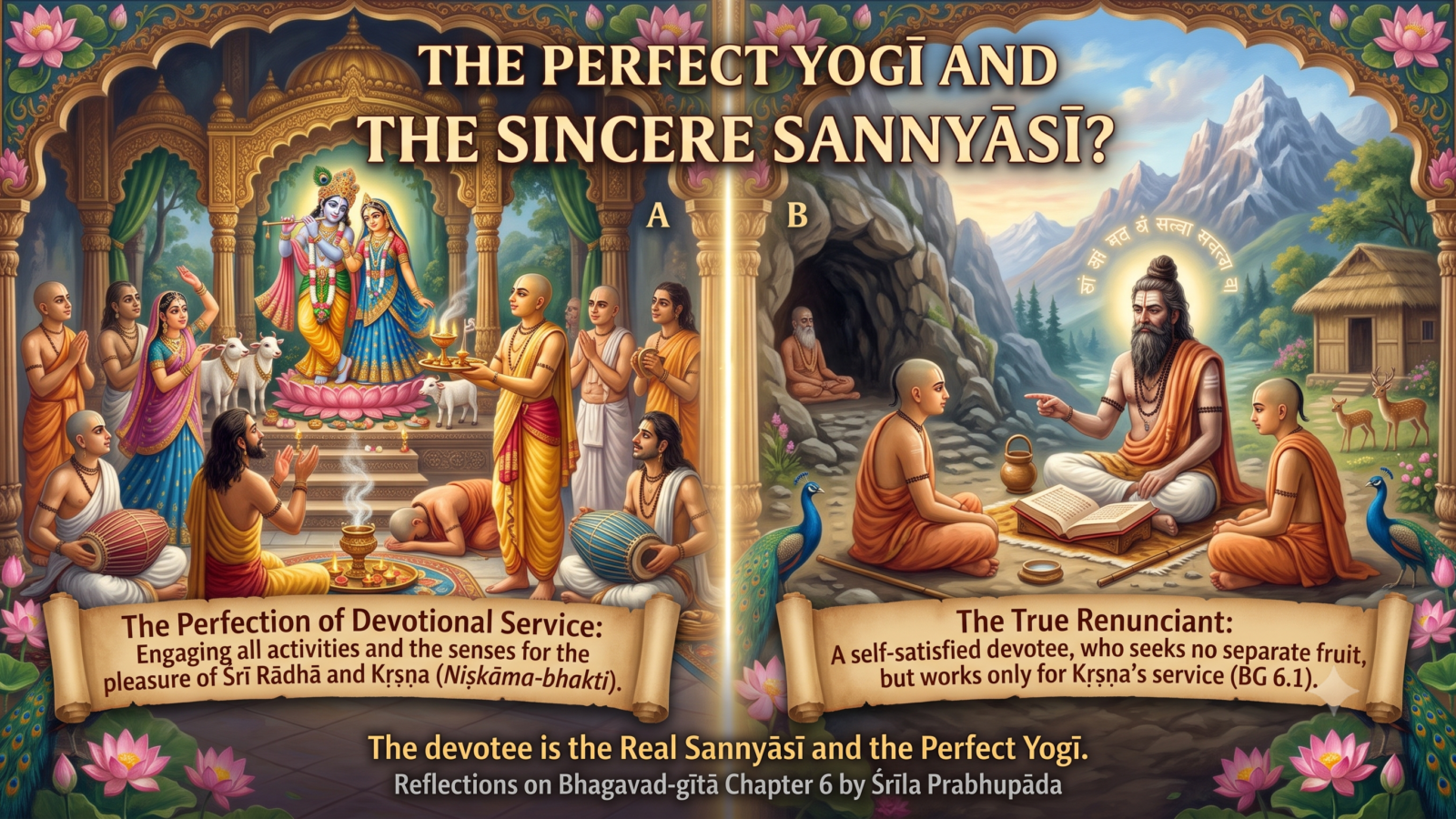
As I am preparing a lecture on the Sixth Chapter of Bhagavad-gītā for my class, reading the first and second verse purports of Śrīla Prabhupāda, I am awe-struck with wonder. While the chapter discusses aṣṭāṅga-yoga, Śrīla Prabhupāda, through his purports, brings us to the ultimate conclusion of all yoga—pure, unalloyed devotional service to Lord Kṛṣṇa.
✨ Who is the real sannyāsī? Who is the perfect yogī?
What especially struck me was the clear distinction between a yogī who is still seeking some form of personal satisfaction and a bhakti-yogī who acts only for the satisfaction of the Supreme Whole, Śrī Kṛṣṇa. The answer given by Lord Kṛṣṇa and emphasized by Śrīla Prabhupāda is clear—the devotee is the real sannyāsī and the perfect yogī.
The yogī is actually self-interested because he desires to become one with the impersonal Brahman. That desire may be transcendental to material desires, yet the goal of the desire is personal satisfaction. In one sense, that desire is greater than any material desire because it seeks liberation and wants to become one with impersonal Brahman; ultimately he wants become supreme. Similarly, a sanyasi may be trying to cease material activities, but still he is desiring some satisfaction for the personal self.
This principle is beautifully summarized by Śrī Caitanya Mahāprabhu in Śrī Caitanya-caritāmṛta:
📖 kṛṣṇa-bhakta — niṣkāma, ataeva ‘śānta’
bhukti-mukti-siddhi-kāmī — sakali ‘aśānta’
(Cc. Madhya 19.149)
“Because a devotee of Lord Kṛṣṇa is desireless, he is peaceful. Fruitive workers desire material enjoyment, jñānīs desire liberation, and yogīs desire material opulence; therefore they are all lusty and cannot be peaceful.”
How profound this statement is! The devotee alone is truly niṣkāma—free from personal desire. Others may have elevated aspirations compared to ordinary materialists, but some form of personal fulfillment still remains the goal.
🌼 The Devotee’s Unique Position
A devotee, however, stands on a completely different platform. A devotee works only for the satisfaction of the Supreme Self, Kṛṣṇa. Therefore, he has no separate self-interest. His happiness is found in Kṛṣṇa’s happiness, and his success is measured by Kṛṣṇa’s pleasure.
When we reflect on this, we can begin to imagine the nature of the spiritual world. It is a realm filled with activities performed only out of true love and completely free from selfish interest. How sweet those activities must be! How glorious are the devotees in Goloka Vṛndāvana, serving the Lord without any personal interest, but solely out of pure love for Him.
🌿 The Difference Between Material and Spiritual Relationships
Externally, the activities there may appear similar to the activities of this world. There are relationships, exchanges, service, affection, and countless varieties of loving dealings. Yet there is a gulf of difference in consciousness.
There, everyone is attracted to the supremely beautiful Lord, yet there is no desire for personal satisfaction. In the material world, it is practically impossible to maintain any relationship without trying to satisfy oneself to some degree.
One may compare it to tasting artificially flavored mango juice made without real mangoes. It may resemble mango juice externally, even similar in taste, but the real substance is missing. Similarly, in this world we experience the external features of relationships, but without the real essence—pure, unalloyed love free from selfish interest.
In the spiritual world, however, relationships possess the real substance that is pure Love. Every exchange is centered on pleasing Kṛṣṇa, and therefore every relationship is fully satisfying and eternally sweet.
🌺 The Topmost Yogīs
In this world, almost every action is influenced by some degree of self-interest. In the spiritual world, every action is motivated only by love for Kṛṣṇa and the desire to please Him.
That is why Śrī Caitanya Mahāprabhu has glorified the gopīs of Vṛndāvana. Their love for the Lord is completely pure, free from any personal motive or expectation. They did not seek material enjoyment, mystic perfection, or even liberation. Their only concern was Kṛṣṇa’s happiness.
Śrī Caitanya Mahāprabhu therefore declared:
📖 ramyā kācid upāsanā vraja-vadhū-vargeṇa yā kalpitā
“The highest and most pleasing type of worship of Kṛṣṇa is that performed by the Vraja gopīs.”
The gopīs are not seeking liberation, mystic perfection, or even their own happiness. Their only desire is Kṛṣṇa’s happiness. Therefore, they represent the highest expression of pure devotion and stand as the topmost example of yoga.
✨ They are the topmost yogīs.
📖 The Perfection of Renunciation and Yoga
The more I read these purports of Śrīla Prabhupāda, the more I appreciate the extraordinary position of pure devotional service. The perfection of renunciation is not merely giving up activities, and the perfection of yoga is not merely controlling the mind. The perfection of both is to engage everything in the loving service of Kṛṣṇa without any personal interest.
Thus, the real sannyāsī and the perfect yogī is the devotee who acts only for the satisfaction of the Supreme Whole, Śrī Kṛṣṇa.
🌸 Hare Kṛṣṇa. 🌸🙏
“One who works as he is obligated without seeking the fruits of his activities is in the renounced order of life, and he is the true mystic; not he who lights no fire and performs no duty.”
— Bhagavad-gītā 6.1 📖✨